
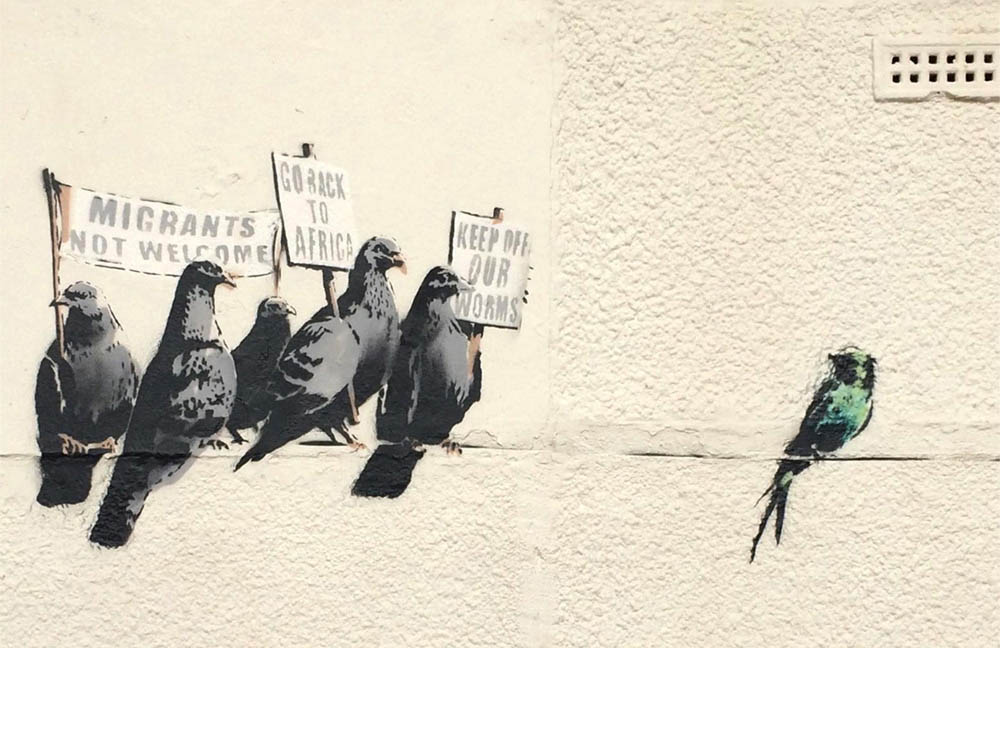
Banksy, Clacton-on-Sea, 2014
Almost everything has been analysed and said about the recent U.S. midterm elections. Surprisingly, though, one aspect has received less attention: the fatigue, among voters in both camps, with division, separation and polarisation. For example, in January 2026, 87% of the people questioned by a RealClear poll for “Unite America” said that Americans were deeply concerned about the political division in their country… Back in 2023 already, the Pew Research Center had found that 65% of the respondents always or often felt exhausted when thinking of politics and the words most used to qualify it were “divisive” and “corrupt”. 61% felt stressed and frustrated at the idea of talking politics with someone of a diverging opinion… Yet, a UMass study (March 2026) found that three-quarters of Americans believe their fellow citizens have more in common than what divides them.
My awareness of the lethal aspect of Polarisation, for Society as a whole, but also for business, sports teams, families etc. dates from 13 years ago (May 2013), when Behavioural Strategist Nick Van Heck and I were driving back from a meeting in Germany. Interrupting the silence, Nick asked: “Do you know what I consider to be the biggest threat to our democracies and businesses?” Since I wasn’t going to take the risk of guessing what was running inside his mind at that precise moment, I remained quiet, assuming the answer would soon follow… “Polarisation! I see polarisation as the biggest threat to our democracies and to our businesses!” Knowing how polarised speakers impoverish any debate, I softly agreed, not willing to argue, tired after a long drive. I realise now how much of a visionary Nick was!
Brazil, Bulgaria, Israel, Serbia and, of course, the United States, or France, in spring 2027 went/will go through painful and destructive election campaigns. The poverty of the political debate is concerning. No conversations nor dialogues, only insults, accusations of bad intentions, no programs, no vision, no pride to be part of a shared national dream. In Brazil, one side won and the other side chose to blame the circumstances and not concede. The danger for the winning side would be to forget the dreadful Ancient Rome episode: the Caudine Forks, in 321 BC. Rather than forgiving the legions by sending them home, or executing them all, the Samnites took the worst possible decision: they humiliated the legionaries, forcing them to kneel and pass under the yoke, and sent them back to Rome half naked and disarmed. Infuriated by this humiliation, Rome waged a merciless, long war, until the Samnites were totally defeated, in 290 BC.
The recent 2026 Edelman Trust Barometer explains perfectly well the dangers of polarisation:
- Polarisation is slowly turning into “insularity”, with a main consequence: People are reluctant to trust other people whose values, information sources or backgrounds differ from their own. Imagine what that means for Business: people avoiding each other, shying away from difficult discussions, bringing the team to its lowest common denominator.
- Mass class divide has doubled, these last ten years… We can certainly see some of its results in Europe at the moment.
- The rise of nationalism means people will trust local brands more than global ones.
- Rejection of innovation (think of A.I.)
Below, Richard Edelman briefly presents the conclusion of the 2026 report.
But why do we so easily fall into the Polarisation trap?
- Our brain is wired to react, and our opponents, consciously or not, know this… And as per Adrian Slywotzky’s book, Value Migration, keeping your opponents on their on the defensive is a sure way to exhaust them.
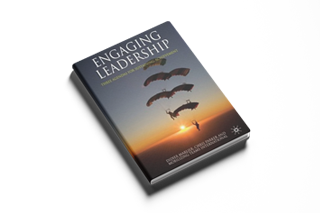
- Our book, “Engaging Leadership”, inspired by the works of Dr Paul MacLean, Daniel Goleman and Dr Henri Laborit, explains how, when fear our Survival (my job, my candidacy), Territory (my self-esteem) and Habits seem to be threatened, it is highly probable that we will immediately react through a hard-to-control “Defence Mechanism” (Fight, Flight, Freeze). Polarisation, with its devastating consequences, is a part of the Fight Mechanism.
- Our poor training in holding difficult conversations (very few business or engineering schools offer it) lets us drift into polarisation rather than co-construction.
- The belief some hold that seeking to understand the “other side” is a sign of weakness, confusing vulnerability with fragility.
Richard Edelman explains that, based on his research, the Employer is critical to have their people and teams leave the dangerous path of insularity: “The primary Trust Broker must be My Employer, proximate and reliable”: You, Business Leaders, are ideally positioned to help your people learn peaceful conflict resolution, hold difficult conversations, and see working with cognitively diverse people as an opportunity.
I can’t forget, almost ten years ago, the two hours taxi ride I took. Brazil was in the middle of an election campaign, and my driver was highly excited and categorical about his political preference and why those not agreeing were “enemies of the nation” and should be arrested! I quickly realised that, having sympathies for the other camp, I wasn’t going to keep my calm for two hours and end up finishing the journey on foot. So I reminded him that we would share this car for two hours, and suggested we turn an oppositional, destructive monologue into an intelligent and human conversation. The rules I proposed were:
- Refrain from trying to convince each other that we are right
- Adopt an honest attitude, assuming the other person probably had good reasons to think differently and seek to understand why
- Focus on our common ground rather than on the points of conflict.
We ended up having a true dialogue we both felt proud of. He still voted for his initial choice, but he remains the taxi I call whenever I work in São Paulo.
I created, with some of my partners at the Enablers Network, a new practice called Depolarisation-Mediation-Development. It helps you change your organisational culture, ensuring that depolarisation, internal tensions and misalignment are not an unavoidable fate and can be worked on!
Enjoy your leadership journey!
0 Comments